
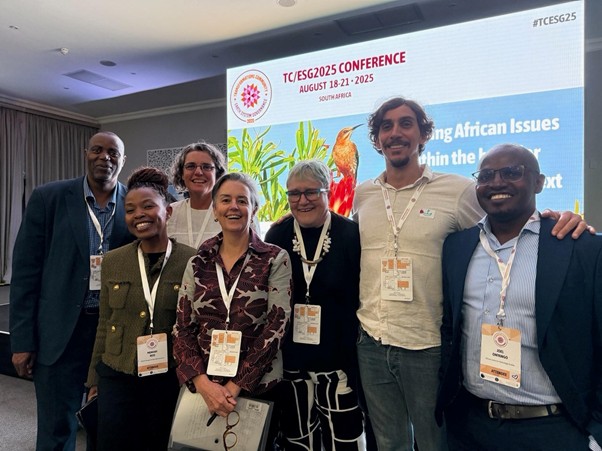
Dr Nyanganyura, Director of the FEAHLC, positioned Africa as a critical site for transformative sustainability science, highlighting the continent’s role not only as a recipient of global frameworks but as a generator of solutions grounded in lived realities. His contribution focused on the work of the Future Earth Africa Hub Leadership Centre in strengthening science systems, advancing transdisciplinary research, and building leadership capacity across Africa. He underscored the importance of co-produced knowledge, policy engagement, and science–society interfaces in addressing interconnected challenges such as climate risk, urbanisation, energy transitions, and social inequality. Drawing on examples from FEAHLC science clusters and Leadership Centre programmes, he illustrated how African research networks are aligning local action with global sustainability agendas while foregrounding equity and inclusion.
Dr Memory Reid, representing both the Global Change Institute and the FEAHLC, complemented this perspective by sharing insights from her work on climate change impacts, adaptation, disaster risk management, and energy transitions. Her presentation highlighted participatory and community-centred approaches that bridge science, policy, and practice. She emphasised the role of early career researchers, youth-led initiatives, and interdisciplinary collaboration in driving innovation and resilience, particularly in contexts shaped by historical marginalisation and contemporary risk.
Together, the contributions of Dr Nyanganyura and Dr Reid reinforced the session’s core message: that African practitioners, scholars, and ‘pracademics’ are actively shaping transformative futures through grounded experimentation, creative integration of art and science, and strong institutional networks. Their participation demonstrated how the FEAHLC serves as a platform for amplifying African voices within global sustainability dialogues, advancing locally rooted yet globally relevant models of transformation, and fostering leadership capable of navigating complex socio-environmental change.