By Lance Myburgh
Scientific progress rarely moves in a straight line. When global attention shifts, entire research fields can lose momentum, leaving gaps that become apparent only decades later. Diseases once thought manageable resurface with new force. Novel pathogens emerge. Health systems struggle to keep pace with technological and social change. These pressures make sustained, contextually grounded research essential, particularly in countries carrying a high burden of infectious and chronic disease. It is within this landscape that Rhodes University’s Faculty of Pharmacy convened its 2025 Research Symposium, a two-day examination of how discovery, innovation and community impact intersect.
Themed From Discovery to Community: Advancing Research towards a Healthier Future, the event brought together academics, students and partners to examine research that connects scientific innovation with public impact.
The Dean of Pharmacy, Professor Sandile Khamanga, opened the symposium by sharpening the purpose of the gathering. “The work that you do is relevant work,” he reminded participants. “It should be locally relevant but also have clear optics for where it is going.” With the faculty approaching its 70th anniversary, he encouraged researchers to anchor their work in the Sustainable Development Goals. “By 2030,” he said, “we should be able to say how our work touches the Sustainable Development Goals.”
On day one, a keynote delivered by Rhodes University’s Professor Setshaba Khanye, a medicinal chemist working in early-stage drug discovery, explored the scientific and human stakes of developing new tuberculosis (TB) treatments. “We still have ongoing projects,” he said, “and we are hoping they will yield something meaningful. TB is not an abstract problem. It is a real issue that has affected people close to me.” He spoke of family members who had died from TB, and of the side effects endured by one relative from life-saving medication. His address underscored the cost of decades of lost innovation and the continuing need for treatments that are safe, affordable and suited to low-resource settings.
On day two, keynote speaker and biochemistry professor, Adrienne Edkins, shifted the lens to proteostasis and molecular chaperones as therapeutic targets in infectious and non-communicable diseases. Her lecture demonstrated how advances in molecular biology and cell regulation are opening new therapeutic possibilities across disease areas. Invited speaker, Rural Health Advocacy Project’s Dr Vatiswa Henge-Daweti discussed pharmacogenomics – a very important branch medicine that enable healthcare providers to select the most effective drugs and optimal dosages for each patient, while minimising the risk of adverse side effects.
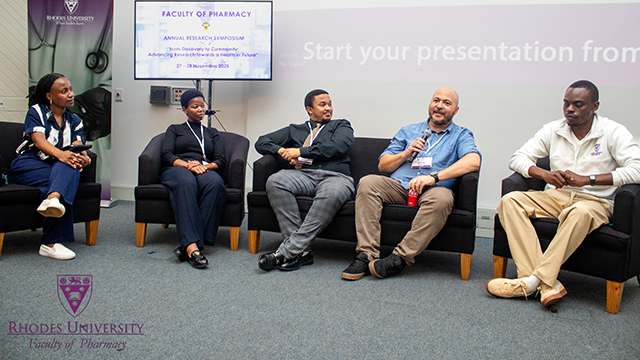
A central feature of the programme was the interdisciplinary panel discussion, Reimagining Health Futures: Integrating Culture, Technology and Precision Medicine in a Transforming Healthcare Landscape, which spanned contributions from biomedical biotechnology, anthropology, nanotechnology, pharmaceutics and pharmacology. The conversation examined how South Africa’s health system is being reshaped by cultural dynamics, emerging technologies and shifting patient expectations. It reinforced a theme woven throughout the symposium: scientific progress must remain anchored in context and community.
Behind the research was also a network of partners who helped make the event possible. The Faculty of Pharmacy acknowledged the generous support of Microsep, National Separations, Anatech, Hanna Instruments and United Scientific, whose contributions strengthened both the programme and the opportunities available to students and staff.
Across the two days, postgraduate researchers presented work in line with the event’s theme, spanning analytical chemistry, drug formulation, traditional medicine, AI-enabled pharmacy education, mental health, and the future of medication adherence. Their contributions further reflected the symposium’s sub-themes: modern drug discovery, computational modelling, therapeutic evaluation, and the role of pharmacy practice in improving wellness across communities.
Their hard work and novel contributions were awarded in a prize-giving, with winners identified as:
- 5 min oral presentation (PhD candidates) - Mr Siphumze Bani
- 10 min oral presentations (Masters and PhD)- Ms Lorah Dzimwasha
- 5min oral presentations (Masters candidates) - Ms Bridget Mtetwa
What emerged over the two days was a portrait of a university advancing research that serves the public good. At a time when global scientific priorities often tilt toward wealthier nations and more profitable diseases, Rhodes University is investing in fields that many institutions once set aside, but which the world urgently needs to solve. As Professor Khamanga told fellow pharmacists and pharmaceutical scientists, “Do not underestimate yourself.”
At Rhodes University, that instruction reads less like encouragement and more like direction.