
By Siyamthanda Hobo
Rhodes Business School and the Anglican theology studies-based College of the Transfiguration (COTT) have been working to strengthen the College’s leadership, refine its strategy, and build institutional resilience through an executive education initiative.
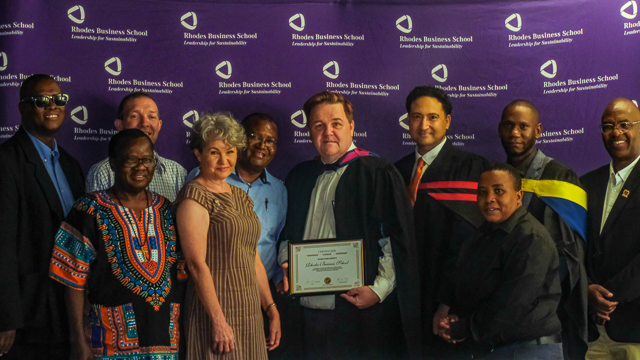
Earlier this week, amid the intense heat and heightened pace that characterise this period in higher education, staff, partners, and graduates gathered at the Rhodes University Centre for Entrepreneurship to mark the culmination of the collaboration.
The event was opened by Evert Knoesen from the Rhodes Business School, who contextualised the partnership within the broader higher education landscape of Makhanda. He reflected on how the initiative emerged from conversations about the need for local institutions to work together more deliberately, recognising that sustainability in higher education depends on cooperation rather than competition.
As the only other degree-issuing institution in Makhanda besides Rhodes University, the College of the Transfiguration occupies a critical position in the local educational ecosystem. The partnership was therefore grounded in the understanding that their futures are interconnected, and that strengthening management and leadership capacity at COTT contributes to the resilience of higher education in the city as a whole.
Learning approaches tailored to a faith-based institution
Rhodes Business School adapted its Leadership Development Programme to the realities of a faith-based institution and worked with COTT on a pro bono basis to help strengthen management capability and institutional strategy. This included people management and strategic operations, while drawing on contemporary management and leadership theory.
The eight participants, which included the Rector and the Registrar of the College, engaged with concepts such as systems thinking (understanding how parts of an organisation connect like pieces in a broader ecosystem), psychological contracts (the unwritten expectations between employer and employee), operational design, value chains (how value is created step by step), and the quadruple bottom line. A strong emphasis was placed on applying these ideas directly to institutional practice, ensuring that learning translated into tangible organisational change.
Impact reflected in institutional renewal and growing confidence
The graduate experience and institutional impact were reflected on by Ms Heloise Dixie, Registrar of the College of the Transfiguration. She highlighted how the programme reshaped approaches to leadership, staff engagement, student administration, and strategic planning within the College. These shifts, she noted, were particularly significant in the context of the challenges faced during and after the COVID-19 pandemic.
Like many higher education institutions, the College of the Transfiguration experienced a sharp decline in student numbers during this period, raising concerns about long-term sustainability. In the most recent academic year, however, student registrations returned to pre-COVID levels for the first time. College leadership attributed this recovery in part to strengthened systems, clearer strategic focus, and enhanced leadership capacity developed through the partnership with Rhodes Business School.
The formal presentation of certificates was conducted by Professor Michelle Karels, Interim Registrar of Rhodes University. Her participation symbolised institutional recognition of the programme and affirmed the importance of collaboration between degree-issuing institutions within the city.
Certificates were awarded to Ms Heloise Dixie, Revd Reginald Leeuw, Revd Dr Berry Muchechemwa, Dr Jonathan May, Revd Dr Celestino Chichimba, Revd Canon Dr Percy Chinganga, and Revd Gcobile Gcina. Several graduates completed the programme with distinction, reflecting sustained academic commitment alongside demanding professional and ministerial responsibilities.
The ceremony also acknowledged the contributions of academic and executive education staff from Rhodes Business School, and of Adv Shuaib Rahim from the Law Faculty, who facilitated the programme, as well as the administrative teams who ensured the smooth coordination of assessments, certification, and logistics. The Centre for Entrepreneurship hosted the event, providing a fitting venue for reflection and celebration.
The proceedings concluded with words of thanks and a shared sense that the event marked not an endpoint, but a foundation for future collaboration. In a higher education sector facing increasing pressure and uncertainty, the partnership between Rhodes Business School and the College of the Transfiguration stands as a strong example of how local, pro bono collaboration can build institutional capacity, resilience, and shared success.