
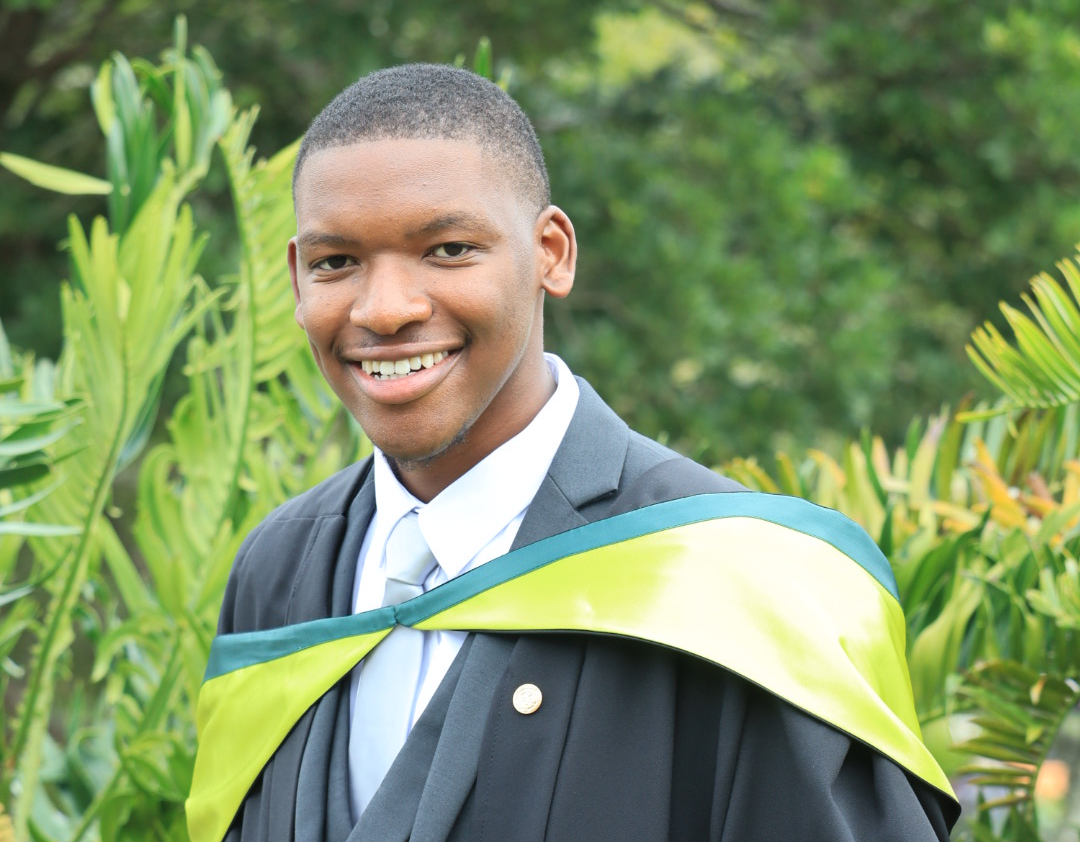
By Ayathandwa Tsili
When Rhodes University Master of Pharmacy graduate Nqobani Mathew Dabengwa began planning his thesis, he chose a path that would take him beyond his discipline and into unfamiliar territory. To understand how students experience mental health support at university, he realised pharmacy alone would not be enough. He would need anthropology.
His Master’s research set out to explore a question many students experience but rarely speak about openly: how well does the University support student mental health, and how do students themselves experience those support systems?
Rather than selecting a more conventional pharmacy research topic, Dabengwa chose to investigate student experience directly. That decision meant learning new theories, new methods, and new ways of understanding people and their stories.
“I’ve always been passionate about mental health,” he explains. “I wanted to understand what the University has in place to support students, but also what students themselves experience. Are the resources enough? Do students use them? If not, why not? And if there are gaps, how can we fill them?”
Supervised by Professor Susan Burton of the Rhodes University Pharmacy Department and Dr Shabnam Shaik of Anthropology at Rhodes University, his work brought together two fields that are not often combined. By approaching the topic from both pharmacy and anthropology, he was able to look not only at systems of care, but also at culture, identity and lived experience.
Research across disciplines
One of the biggest challenges of the project was conducting interdisciplinary research at Master’s level. Because part of the supervision was based in Anthropology, Dabengwa had to engage deeply with theories and perspectives outside his original training.
“I had to read a lot of anthropology and try to understand different ways of looking at people and their experiences,” he says. “Then I had to make sure the pharmacy side and the anthropology side spoke to each other in a way that made sense.”
He could have chosen a more traditional pharmacy topic. Instead, he chose a question that required him to step beyond his comfort zone and learn a different way of understanding how students make sense of their experiences of support.
Funding also proved to be one of the biggest obstacles during the research process. Despite these challenges, the work opened opportunities to present his findings at several conferences, including the Academy of Pharmaceutical Sciences, where his presentation received a joint first-place award.
“I think presenting the work to different audiences really helped,” he says. “People would ask questions, share their own experiences, or tell me about initiatives they were involved in. That made the research feel alive.”
Mental health beyond the classroom
Through interviews with students, Dabengwa discovered that mental health experiences are shaped not only by academic pressure, but also by culture, gender expectations and personal background. Much of his research focused on Black students, reflecting the demographics of the institution, and many participants spoke about how their upbringing influenced the way they understood mental health.
“Some students spoke about growing up in environments where you don’t talk about emotions, especially men,” he explains. “You’re told to be strong, to provide, not to cry. Then you come to a university space where suddenly you are encouraged to talk about how you feel, and that can be a very new experience.”
Others shared that they felt more comfortable speaking to counsellors who understood their cultural background, or who they felt they could relate to more easily.
“These were things I didn’t expect to come up,” he says. “It showed me that mental health support isn’t just about having services available. It’s also about whether students feel safe enough to use them.”
From research to real conversations
Some of the most meaningful moments of the project happened outside the formal research setting. Dabengwa was invited to speak to student mentors and later worked with them to create a student mental health toolkit based on their own ideas and experiences.
“To see students tell me what they need, in their own words, was very powerful,” he says. “We were not just talking about theory anymore. We were creating something together.”
He also participated in student-led mental health discussions and community activities, including a mental health awareness hike organised with a student society. These experiences challenged him to present his work in ways that went beyond academic presentations.
“When you speak at a conference, there’s a structure,” he says. “But when you talk to students in a real setting, you have to think differently. It’s just you, your words, and the people in front of you.”
Seeing students from a place of abundance
One of the most important lessons Dabengwa says he learned during the research was to approach people from a place of respect rather than assumption.
“I realised that people are not waiting to be saved,” he says. “Students already have ways of coping, ways of supporting each other, ways of making sense of their experiences. As a researcher, you are not coming to fix people. You are coming to learn with them.”
He prefers to describe the students who participated in his study not as subjects, but as co-creators of knowledge.
“When someone shares their story with you, there’s a responsibility to tell it well,” he says. “That work became more than just a thesis. It became something we created together.”
This perspective also connects to his work outside academia, where he is involved in creative and community-based projects that give a platform to voices that are often unheard. Through storytelling, publishing and community engagement, he hopes to continue creating spaces where people can share their experiences openly.
What universities can do better
While his research highlighted the support systems already available at Rhodes University, it also showed that many students are not aware of them, or do not always feel comfortable using them.
“Sometimes the services exist, but students don’t know about them,” he says. “Or they think you only go there when something is wrong, instead of seeing it as a space for guidance and support.”
He believes universities could improve by including more student voices when designing mental health programmes, and by making support structures more visible across faculties.
“Students suggested things like having a mental health liaison in each faculty, instead of everything being in one place,” he says. “That could make it easier for people to reach out.”
Looking ahead, he hopes to continue working in this field, possibly through doctoral study, with a focus on community-based approaches to mental health support.
For Dabengwa, the message at the heart of his research is simple.
“Seeking help doesn’t mean you are failing,” he says. “It means you are building a community. And sometimes, allowing yourself to be supported is the strongest thing you can do.”