How a newspaper headline sparked research into recycling’s role in reducing poverty in the Eastern Cape
Date Released: Thu, 2 April 2026 04:18 +0200By Ayathandwa Tsili
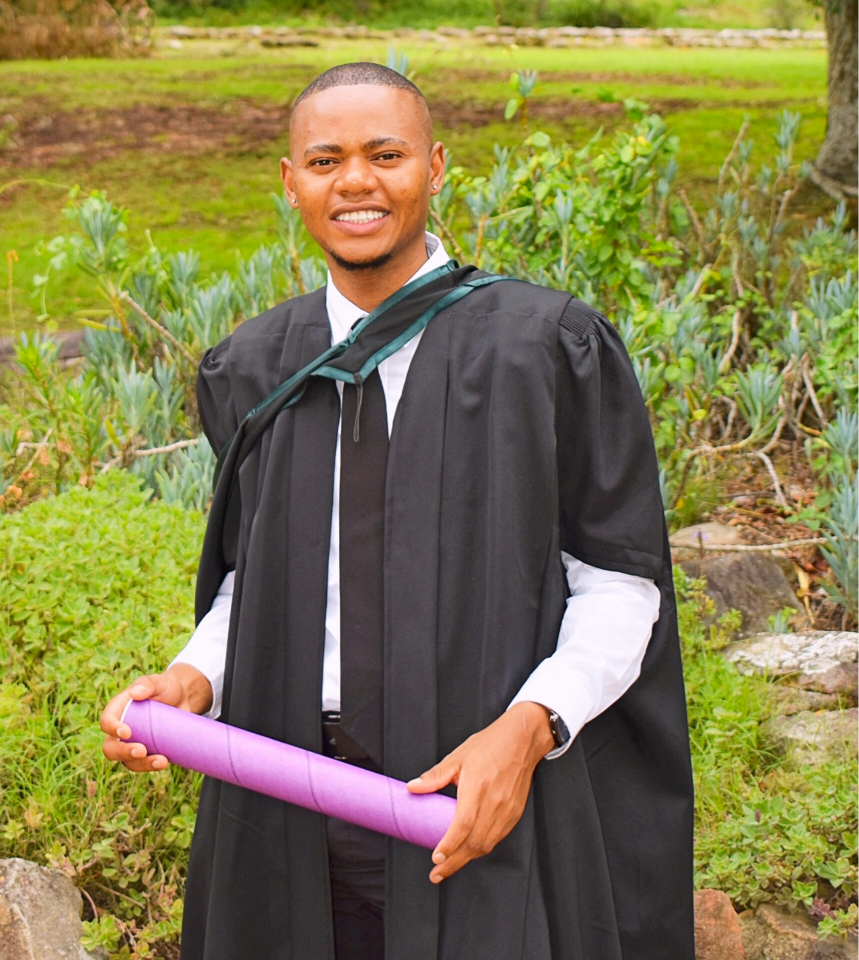
A newspaper headline about a dumping site near a school was not meant to change anyone’s life — but for Rhodes University MSc in Environmental Sciences graduate Khangelani Dlamini, it did.
“I remember seeing a headline about a large waste dump near a school in Makhanda,” Dlamini recalls. “It was a serious public health concern.”
For many, it might have been just another troubling story. For Dlamini, it became a turning point. It raised two important questions that would shape his research and his purpose: why are the problems we see every day still unresolved, and what can we do about them?
“I realised that as academics, we shouldn’t look far for problems to solve,” he says. “We should look at the communities we are in.”
Dlamini’s research, supervised by Associate Professor Gladman Thondhlana of the Department of Environmental Science at Rhodes University, reflects this commitment to addressing real-world challenges within local contexts.
A passion grounded in people
With an interest in sustainability, Dlamini’s academic journey began with a degree in Geography and Environmental Management, followed by honours in the same field at the University of KwaZulu-Natal. During this time, Dlamini discovered something surprising about himself: “I really fell in love with teaching,” he says. “I realised that my purpose isn’t just to understand sustainability, but to make the next person understand it as well.”
Sustainability, he explains, is often treated as an abstract concept, something distant and difficult to grasp. For Dlamini, the goal became clear: to make it practical, accessible and meaningful in people’s everyday lives.
This passion led him to complete a Postgraduate Certificate in Education (PGCE) before pursuing his master’s degree at Rhodes University. It also shaped how he approached his research, not just as an academic exercise, but as something that should speak directly to people’s lived experiences.
Seeing recycling differently
At the heart of Dlamini’s research is a simple yet powerful idea: recycling is more than an environmental responsibility. It is also an untapped economic opportunity.
“In many developed countries, recycling is not just about reducing waste,” he explains. “It’s also about creating jobs and supporting economic growth.”
During his studies, including an academic exchange in Germany, Dlamini was exposed to systems where recycling plays a central role in both environmental sustainability and economic development. These experiences sharpened his perspective on South Africa’s approach.
“In South Africa, we tend to look at recycling only from an environmental standpoint,” he says. “But in a country facing unemployment and poverty, we need to explore its economic potential as well.”
The people behind the system
To understand this potential, Dlamini focused his research on Makhanda and Port Alfred, Eastern Cape, examining both the opportunities and barriers to recycling.
Central to his study were waste pickers, individuals working in the informal recycling sector who collect and sell recyclable materials for income.
“These are people who depend on waste to survive,” he explains. “They collect materials and are paid based on how much they gather.”
What he found was both encouraging and deeply concerning.
On one hand, many waste pickers were earning above the extreme poverty line in South Africa, highlighting recycling’s potential as a tool for poverty reduction. On the other hand, their working conditions were often harsh and unsafe.
“Some of them don’t even have basic protective equipment,” Dlamini says. “They work long hours, exposed to harmful materials.”
His research also revealed gender inequalities within the sector, with women often earning less due to the physically demanding nature of the work and broader social challenges.
“These are real people facing real struggles,” he reflects. “It’s not just data, it’s people’s lives.”
Why recycling isn’t happening
Despite this potential, recycling rates in Makhanda and Port Alfred remain strikingly low, with fewer than 10% of households participating consistently.
“When we asked people why they don’t recycle, the answers were very clear,” he says.
One of the biggest barriers is infrastructure. Many households simply do not have access to recycling bins or proper waste separation systems.
“Even if people want to recycle, they don’t have the resources to do it,” he explains.
A lack of awareness is another major issue. The study found that very few people had ever received formal education about recycling or its importance.
“If people don’t understand it, they’re not going to do it,” Dlamini says.
But perhaps the most important finding was what he describes as an “action gap” — a disconnect between knowledge and behaviour.
“Even when people know what recycling is, they can’t act on that knowledge if the infrastructure isn’t there,” Dlamini explains. “So the knowledge becomes useless.”
Looking ahead
Now working as a high school teacher, Dlamini continues to carry forward both his research and his passion for education. He remains focused on making sustainability accessible and relevant while also exploring opportunities for further research.
For Dlamini, the journey has always been about more than academic achievement. It has always been about purpose, people and impact.
“Choose something that moves you,” he says. “Something you are passionate about, something you think about even in the middle of the night.”
Khangelani Dlamini’s thesis is titled ‘An Assessment of Opportunities and Barriers to Recycling in Two Medium-Sized Towns of Makhanda and Port Alfred, South Africa’
Source:Communications