
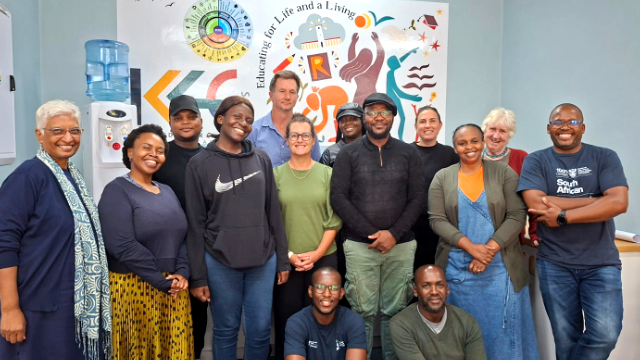
In a South Africa grappling with inequality, mistrust in institutions, and the urgent need for social cohesion, Rhodes University has introduced a programme designed to reset how universities understand their purpose. The Postgraduate Diploma in Higher Education: Community Engagement (PGDip HECE) is the first professional qualification of its kind in the country, offering academics and practitioners a structured way to integrate meaningful engagement into teaching, research, and partnership-building.
For Diana Hornby, Director of the Community Engagement Division, this moment has been a long time coming. “Universities have always been known for teaching and research,” she says, “but the world is asking something more of us now. Community engagement is no longer a ‘nice to have’. It’s a core duty of higher education if we want to remain relevant and ethical.”
Building universities that serve the public good
The need for this qualification reflects a national gap. As Hornby explains, “There is currently no formal qualification for community engagement in South Africa. Most practitioners learn by doing, often without grounding in theory, ethics or critical pedagogies. This programme begins changes that.”
The PGDip HECE
The PGDip HECE, currently in its first run, asks hard questions about the role of universities in an unequal society, encouraging students to consider epistemic and social justice, ‘knowledge democracy’, Ubuntu, and the cultivation of humanity.
To bridge the gap between theory and action, the curriculum is structured around six compulsory components:
- Higher education and community engagement: Examining the core concepts and social responsiveness of institutions.
- Volunteerism and active citizenry: Focusing on the agency and solidarity required for social change.
- Critical service-learning: Mastering critical constructivist pedagogy to facilitate authentic learning.
- Engaged research: Grounding scholarly inquiry in ethical and methodological integrity.
- Community engagement praxis project: A practical exercise where students choose between an Engaged Citizenry or Service-Learning focus.
- Community-Based Participatory Research (CBPR) Project: A collaborative knowledge-making module designed to produce research with communities.
Hornby emphasises the programme’s transformative intent. “If we truly believe universities are for the public good, then our work must be relational. This qualification prepares people to co-produce knowledge with communities, not for them.”
Preparing a new kind of academic leader
Looking ahead, Hornby hopes the first cohort becomes more than graduates. She hopes they become catalysts. “I want them to feel confident working in ways that are deeply developmental, that centre human wellbeing, and that help universities respond to South Africa’s burning issues,” she says.
The programme encourages cohorts to become communities of practice, bridging disciplines and sectors.
“If our graduates leave with one shift, I hope it is the recognition that transformation begins with the individual but is only meaningful when it leads to collective wellbeing. That is the heart of community engagement,” Hornby explains.
By formalising Community Engagement as a scholarly, rigorous, and ethically accountable field, Rhodes University is not only filling a national vacuum, but strengthening its commitment to shaping ethical leaders, critical citizens, and socially responsive graduates.
For more information, contact: Dr Gamuchirai (Gamu) Chakona: gamuchirai.chakona@ru.ac.za | 046 603 8571