By: Lance Myburgh
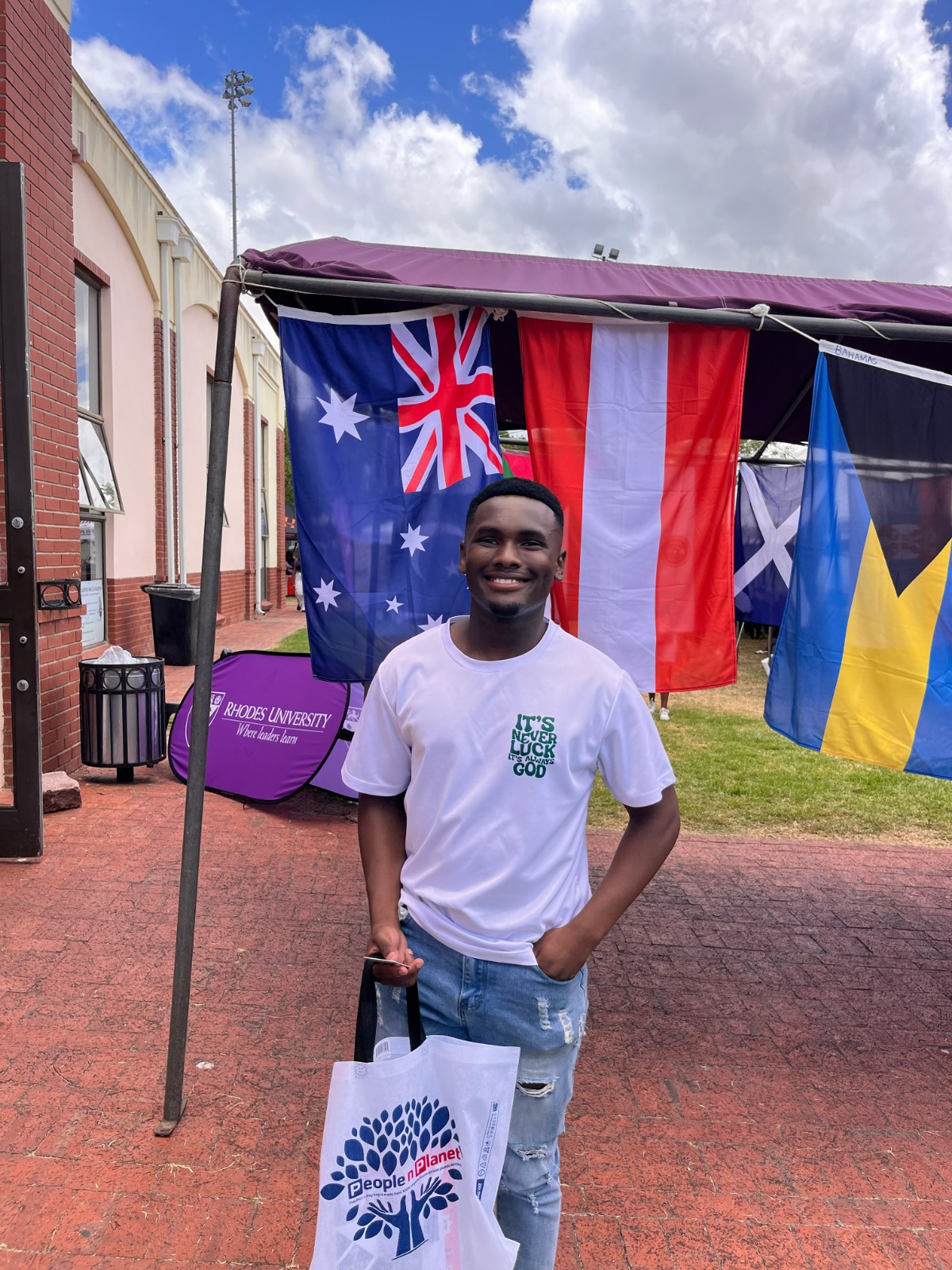
For Sinelizwi Dyibishe, arriving at Rhodes University was not about proving that he had never stumbled. It was about recognising that the moments where things did not go according to plan had taught him the most. Standing on campus as a newly registered first-year, he carried with him more than acceptance letters and official documents; he carried a deeper understanding of what learning can look like when it does not end at failure.
“When I got my student card,” he said, “I was actually relieved. I realised that, okay, the process is finished now. I’m 100% in.”
That sense of relief did not come easily. Born and raised in Grahamstown, Sinelizwi attended George Dickerson Primary School before moving on to Mary Waters High School. His family roots are firmly local, and so were the pressures that shaped his schooling. Like many learners, he faced the challenge of developing academic discipline in an environment filled with everyday distractions and competing priorities. “It was hard to transition into a disciplined mindset,” he reflected. “Studying every day, making sure everything is up to date and organised.”
When his matric results did not meet his expectations, the disappointment was real. But instead of treating that moment as an ending, Sinelizwi learned to see it differently. That shift in thinking would become the turning point in his educational journey. “I believe that failure is also a learning path,” he said. “I once heard someone say failure is the first attempt in learning.”
The idea that failure can be productive rather than permanent lies at the heart of Rhodes University’s approach to widening access and student success. Through decades of research into learning, inequality, and transition, the University and its partners have shown that academic outcomes improve when students are supported to reflect, adapt, and grow, rather than being defined by a single result.
For Sinelizwi, that support came through GADRA Education, a long-standing partner of Rhodes University whose work is grounded in research on access and second-chance pathways. “At first, I was hesitant,” he admitted. “But I came to learn that for me to fail is for me to learn something by experience, instead of hearing it from someone else. “That experience reshaped how he saw himself, not just as a student trying to pass, but as a learner developing resilience, maturity, and purpose.
“GADRA is quite a small school,” he said, “but it makes such a big difference. It is a small school that makes a big impact. “The impact on Sinelizwi was not only academic. It was personal. He described a complete shift in mindset from how he attended classes to how he thought about his future. “My mindset changed completely,” he said. “There was a transition.”
That transition was intentional. Research into student preparedness consistently shows that the move from school to university can be overwhelming, particularly for students from under-resourced backgrounds. GADRA’s model responds to this by blending academic rigour with guidance, structure, and care. “They try to give you a GADRA experience mixed with a bit of varsity,” Sinelizwi explained, “so that when you get to university, you won’t be lost, confused, or overwhelmed.”
He confirmed that the institution is abundant with affection and gratitude. “It’s like a second home,” he said. “They treat you gently, but they also prepare you. “That preparation mattered on registration day at Rhodes. After months of uncertainty, including fears sparked by stories of withdrawn offers, the moment of arrival brought clarity.
“The future was undetermined,” he said. “But when I came in and actually registered, I knew I was in the right place.” The atmosphere surprised him. “It was warm,” he said. “People were excited to welcome you. It felt like they had been waiting for you.”
Now registered for a Bachelor of Social Sciences, Sinelizwi looks ahead with ambition and honesty. He speaks openly about success, discipline, and the reality that plans may change — but learning will continue.
“I see myself as a millionaire,” he said with a laugh. “I’m still figuring out how I’m going to get there, but I believe I will.”
More importantly, he understands that the journey will not be linear and that failure, when appropriately supported, can become fuel rather than a finish line.
As Rhodes University continues to invest in research that addresses inequality and expands access to meaningful education, stories like Sinelizwi’s show what that work looks like in practice. They remind us that when institutions treat failure not as an endpoint, but as a site of learning, they do not just change academic trajectories but change lives.
On a day filled with beginnings, Sinelizwi’s registration stands as quiet proof that learning does not stop when things go wrong. Sometimes, that is precisely where it starts.