
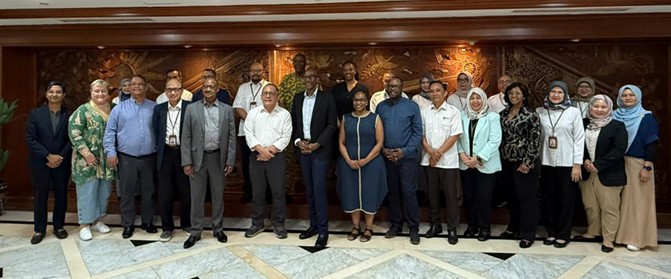
The mission commenced on 19 July 2025 with preparatory engagements in East Java, including meetings with Universitas Negeri Malang and selected universities in the region. These discussions focused on institutional introductions, sharing of research strengths, and identification of complementary priority areas. The engagements provided an important platform for exploring university-to-university collaboration, particularly in joint research initiatives, postgraduate training, and academic exchanges.
On 20 July 2025, the delegation engaged with the National Research and Innovation Agency (BRIN), where an overview of Indonesia’s national STI landscape and research coordination mechanisms was presented. Discussions highlighted BRIN’s role in shaping national research priorities and facilitating international collaboration. A joint roundtable discussion with BRIN and the Ministry of Higher Education (MOHE) was held on 21 July 2025. The dialogue focused on aligning national STI priorities, identifying opportunities for bilateral and multilateral programme development, and exploring mechanisms for researcher mobility, capacity building, and joint funding. Particular emphasis was placed on advancing structured South–South and triangular cooperation frameworks. The mission concluded on 22 July 2025 with a roundtable discussion with BKS-PTN Barat, the consortium of public universities in Western Indonesia. Discussions centred on collaborative models for universities, development of research networks, joint postgraduate programmes, and strategies for sustaining long-term institutional partnerships.
Overall, the mission strengthened relationships between African and Indonesian stakeholders, identified priority areas for collaboration, and established a foundation for co-designing future joint programmes and exchanges in support of South–South cooperation objectives.