The TERRA+ School was designed as an intensive learning and reflection space that emphasised the integration of scientific knowledge with societal perspectives. From the outset, the programme fostered a shared understanding of transdisciplinary as a collaborative research process in which academic researchers work closely with non-academic actors, including policy-makers, practitioners, and communities, to co-produce knowledge that is both scientifically robust and socially relevant. This framing was particularly valuable in highlighting the limitations of siloed disciplinary approaches when confronted with multifaceted and interlinked sustainability problems.
The sessions focused on building a common conceptual foundation, introducing participants to the rationale, evolution, and practical implications of transdisciplinary research. Through facilitated discussions and case study presentations, participants explored real-world examples that illustrated both the promise and the challenges of transdisciplinarity, including issues of power dynamics, stakeholder inclusion, and managing diverse forms of knowledge. These discussions encouraged critical reflection on participants’ own research practices and institutional contexts. A central strength of the programme was its strong emphasis on practical tools and methodologies. Interactive workshops enabled participants to engage deeply with techniques for diagnosing complex or “wicked” problems, stakeholder mapping, and identifying shared objects of interest that can bridge disciplinary and societal divides. These hands-on sessions translated theory into practice and provided transferable skills that participants could adapt to their own research settings.
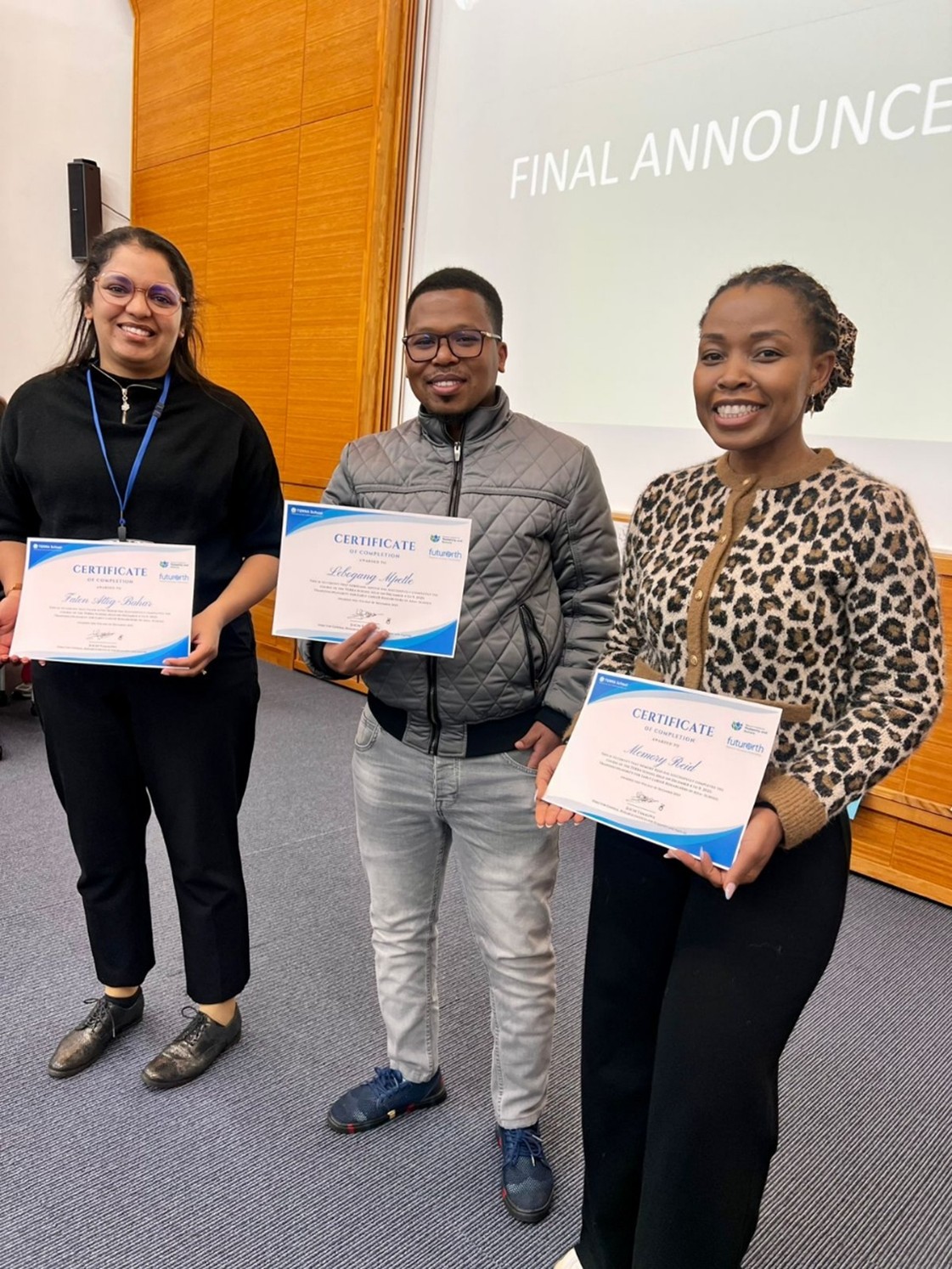
The participation in the TERRA+ School significantly strengthened capacities in transdisciplinary research, stakeholder engagement, and sustainability leadership. The experience was directly relevant to ongoing work in sustainability science and capacity development, particularly within Global South contexts. The programme provided valuable insights, professional networks, and practical skills that will inform future research, collaboration, and policy engagement efforts. Three ECRs from Africa (Dr Memory Reid, Dr Faten Attig Bahar, Mr Lebogang Mpetle) participated during the training.
Three staff members from the Future Earth Africa Hub (FEAH) and its Leadership Centre - Mr Michael Nxumalo, Prof. Cyril Mbatha, and Dr Daniel Nyanganyura - participated in the TERRA+ School as observers. Their observer status provided a valuable opportunity to engage directly with researchers from the Research Institute for Humanity and Nature (RIHN) across a range of programmes, research themes, and methodological approaches. Through structured sessions and informal interactions, the observers gained in-depth insights into RIHN’s integrative research models, particularly its emphasis on transdisciplinary, problem-oriented sustainability science that bridges natural sciences, social sciences, and humanities. Importantly, the observers’ engagement fostered relationship-building and trust, laying a foundation for future collaboration between the Future Earth Africa Hub, its Leadership Centre, and RIHN. Engagements with TERRA+ School faculty and participants highlighted innovative approaches to research training, early-career capacity development, and the embedding of co-production principles within sustainability research practice.
The observers’ participation and engagement with TERRA+ School and RIHN researchers added strategic value by strengthening institutional linkages, enhancing mutual understanding of research and capacity-building approaches, and advancing the shared objective of developing context-responsive, globally connected sustainability science leadership.