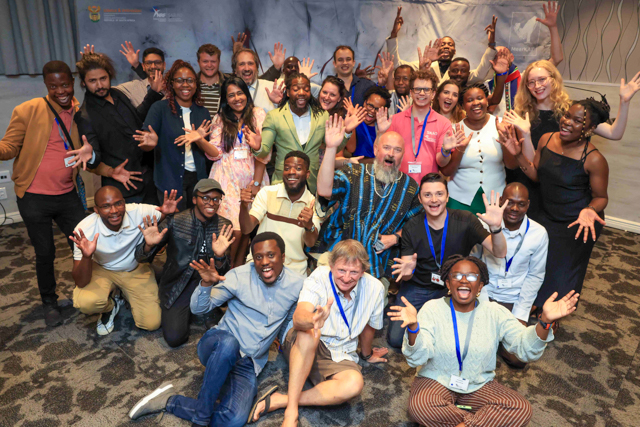
The 2025 SARAO Postgraduate and Postdoctoral Scholarship Conference (24–27 November), a vital gathering for South Africa’s rapidly advancing radio astronomy community, marked its 20th anniversary this year.
Yet to understand the momentum behind the Rhodes University researchers presenting their work, one has to look back to a moment when the field itself nearly vanished from the South African landscape. Two decades ago, radio astronomy at its foundational home was close to disappearing, only to rise and become one of the country’s strongest engines for scientific talent.
In 2000, South Africa’s radio astronomy capacity was almost non-existent. Only five radio astronomers worked in the entire country, and Rhodes University, then the sole institution offering formal courses in the discipline, was on the brink of shutting down its Department of Physics and Electronics - an especially painful prospect given the University’s pioneering role: since 1975, it had been the country’s lone academic custodian of radio astronomy.
The spark
The spark that prevented this collapse came from Professor Justin Jonas, Rhodes University alumnus and faculty member. Prof Jonas, who would later be affectionately referred to as the "pre‐eminent intellectual guru" of the Square Kilometre Array (SKA) project by Dr Bernie Fanaroff, saw the immense potential of what was then a "wild dream".
In February 2001, he formally presented the proposal to local astronomers and soon became its global champion. His role blended visionary thinking, scientific rigour, political navigation, engineering insight, and persuasive advocacy. While travelling internationally to promote the SKA, he continued teaching first-year tutorials and supervising postgraduate students at Rhodes University. His relentless efforts helped secure South Africa’s position in the global project and ultimately led to the development of the MeerKAT array, the SKA’s acclaimed precursor.
When the South African government committed to competing for the SKA around 2003, Rhodes University’s future shifted dramatically. The University’s longstanding foundation in radio astronomy became indispensable. Even before the formal establishment of the SARAO Research Chair for Radio Astronomy Techniques and Technologies (RATT) in 2012 under Professor Oleg Smirnov, Rhodes University was already training students and undertaking the kind of work that RATT would later formalise.
Human capital impact and growth
The scale of this transformation is most clearly seen in Rhodes University’s human capital impact. RATT enrolled only three postgraduate students in 2005. In 2025, that number has risen to 31. Over two decades, the programme has trained 112 Masters, Doctoral and Postdoctoral researchers, an extraordinary turnaround for a field once considered too small to survive.
The strength of this pipeline was fully visible at the 2025 SARAO conference. A significant cohort of presenters is affiliated with Rhodes University, showcasing work that ranges from diffuse radio emission and galaxy evolution to advanced software development for next-generation telescopes.
RATT researcher Dr Kenda Knowles, who serves as the Chair of the conference’s Scientific Organising Committee, said: “Each year, I listen to the work being done by postgraduate students across the country and find renewed enthusiasm for research, new opportunities for collaboration, and new research directions. I came away from this year’s conference, now 20 years after the HCD efforts began, with a joyful confidence that the future of radio astronomy in South Africa is in good hands.”
Dr Knowles also supervises several of this year’s presenters, including Dr Swarna Chatterjee and Ms Janie du Preez. Her dual role as Chair of the conference committee and RATT Senior Researcher allows her to witness South Africa’s human capital development first-hand while actively driving it. Her research group at Rhodes University currently comprises two postdoctoral fellows, two PhD candidates and two MSc students, with three additional PhDs beginning in 2026, and she co-supervises four more students at universities across South Africa; a marked trajectory of growth from RATT’s initial three enrolled students in 2005.
Fellow RATT researcher, Dr Mpati Ramatsoku, who began as a beneficiary of the SARAO HCD programme, now supervises several postgraduate students and collaborates with postdoctoral researchers, a sharp illustration of how the programme’s growth enables its alumni to become drivers of the next generation. Her early involvement allowed her to attend and present at every annual conference as her work progressed.
“A highlight was being invited back as a guest speaker two years ago, following my return to SARAO as a research fellow at Rhodes University after completing a postdoctoral position abroad,” she added.
This year’s conference also saw the launch of the SARAO Alumni Network, a timely development for a community whose human capital now stretches well beyond its origins. “It is an excellent way for us to stay connected, see what everyone is doing now, and find new opportunities to work together. It also creates more ways to share astronomy with the broader community. For example, I know of two SARAO alumni who are interested in combining music and astronomy for outreach purposes. A network like this makes it much easier for ideas like that to find the right collaborators and reach the public,” Dr Ramatsoku stated.
The story of Rhodes University’s radio astronomy programme is ultimately one of resilience and vision, of a department that went from near-extinction to becoming a national leader in developing the scientific and engineering talent powering South Africa’s contributions to the global astronomy frontier.
It shows that the world’s most ambitious scientific instruments are built not only from metal, electronics and fibre optics, but from the determination to invest in people.
Related RATT articles:
The MGCLS II catalogue: listening to the quiet signals that shape our Universe
Decoding the cosmos: how Dr Lexy Andati’s scientific software makes raw space data make sense