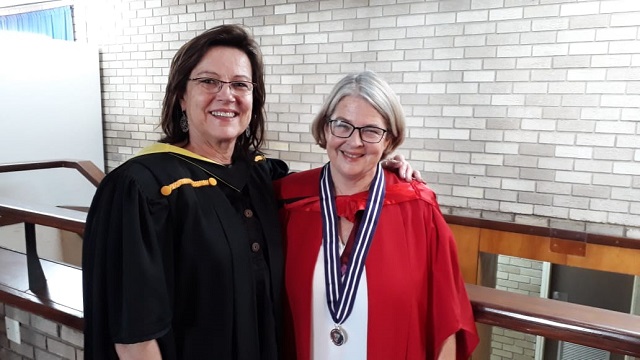
On Thursday 11 April at one of Rhodes University's five 2019 graduation ceremonies, Professor Tally Palmer received her 2018 VC’s Distinguished Award for Community Engagement.
The Vice-Chancellor’s Distinguished Community Engagement Award is presented annually to a Rhodes University staff member who has dedicated their time, skills, knowledge and expertise to forge mutually respectful, beneficial and socially significant initiatives and partnerships to address the national development agenda.
Professor Carolyn (Tally) Palmer trained as an ecologist and completed her Honours, Masters and PhD at Rhodes University. Professor Palmer has been involved in the Institute for Water Research (IWR) since 1992 moving from senior lecturer to full professor. In November 2016, Tally was appointed as the Director of the IWR.
Since 2013 Tally’s main engaged research activities have been undertaken in the area of Integrated Water Resource Management, where she has worked extensively in the Upper Kowie and Crocodile River catchments. Several integrating systemic approaches were adopted in this work, including strategic adaptive management, systems thinking, soft system modelling, and system dynamics modelling. Strategic Adaptive Management (SAM) is a systemic, inclusive process that is particularly attentive to developing a rich understanding of; a shared articulation of values and the co-development of a vision of a shared future. The use of SAM was taken further by paying specific attention to ensuring stakeholders participating in any of the research processes (planning, data collection and analysis, and knowledge sharing) were able to participate fairly. This required attention to the context of knowledge sharing, making use of translation where appropriate, as well as demonstrating an inclusive and invitational attitude in explicitly inclusive processes. All of this was part of Tally’s intentional focus on paying attention to epistemic justice - the fairness and equity of participation in water resource management.
Her work in the Upper Kowie catchment was engaged at the local government (Makana), subcatchment scale, and has accelerated local water institutional development with the establishment of the first South African Water, Sanitation and Catchment Management Forum. The combined forum is actively co-hosted by the Makana Municipality and the Department of Water and Sanitation. The forum, called the “Makana Water Forum” by participants, is actively developing a local catchment management strategy (CMS) for the Upper Kowie River Catchment to contribute to household water security. To date more than 85 stakeholders, widely and deeply representative of local interests have actively participated in the Makana Water Forum. Tally is already extending this ground-breaking and exemplary research to the Tsitsa River Catchment.
Working in the Crocodile River Catchment, Tally addressed the Adaptive Integrated Water Resource Management challenge of building a co-operative integrated water quality monitoring process, to forge solutions to deteriorating water quality as a threat to water resource protection. The research built stakeholder capacity to co-operatively change behaviour and collectively improve water quality, and as improvements in the ecological Reserve indicators were monitored, community driven resource protection in action was seen. This ground-breaking work brought many large industries together (including sugar, pulp and paper, and mining industries), with local government, water service providers, water managers, and regulators. Stakeholders met three times a year for two years, and then handed stakeholder engagement to the Crocodile Water Management Forum which had been established.