From strengthening basic education to tackling pollution, sustainable development is deeply connected with people on the ground. Though often discussed in academic halls and international headquarters, it is within and through communities that lasting transformation occurs. Professionals from all walks of life often find themselves trying to facilitate this kind of sustainable change through formal or informal education, but they don’t know where to start.
Through the ELRC’s Postgraduate Diploma (PG Dip) in Sustainability Learning, people can discover new ways of engaging with communities for meaningful transformation, while expanding their own worldviews.
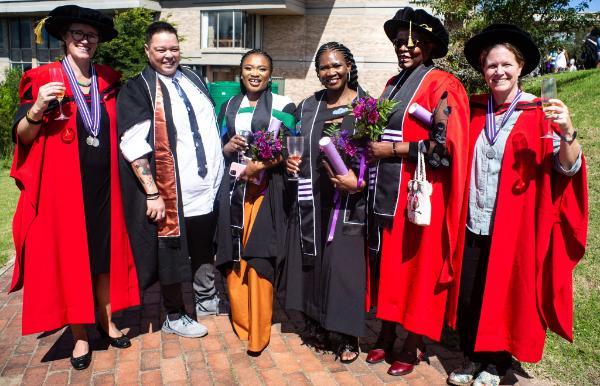
Founded by Associate Professor Lausanne Olvitt (ELRC) and Dr Jessica Cockburn (Department of Environmental Science) in 2023, the PG Dip has reached a milestone with its first cohort of students graduating in April 2025.
“Through the skills we’ve helped to develop and deliver in the course, we are trying to equip the PG Dips to create learning spaces that bring change,” explains former programme co-lead, Olvitt, “[After this course], graduates can work as educators in a variety of sustainability projects and initiatives that can really have an impact, and [little by little], we are getting closer to reaching the sustainable future we want.”
Teaching and learning from below
Sustainability education combines a focus on sustainability with education, aimed at using learning interventions to tackle societal challenges from poverty and environmental crises to gender inequality and illiteracy. But this is not a simple top-down classroom approach to education.
A central principle in the postgraduate diploma is how learning interventions need to start within each person, and be fuelled and guided by grassroots movements and communities to be sustainable. Working in collaboration with groups who are directly affected by projects in this way can create long-lasting change.
But this requires different ways of facilitating learning and transformation which involve, empower, and are co-guided by people on the ground. This is why training people in the tools and practices of sustainability learning has the potential to deepen and enrich community and societal interventions across the country in different sectors.
A flexible, inclusive, and practical course
The postgraduate diploma is offered part-time over two years and is the first of its kind in South Africa, making it appropriate as a stepping stone for full-time working practitioners and professionals wanting to strengthen their roles as informal or formal educators.
Given how sustainability and learning are relevant to far reaching fields and sectors, the diploma is open to people from a diversity of backgrounds and disciplines. The first and current cohort of PG Dip students have backgrounds ranging from environmental science and education to economics, fashion, and digital marketing. The course can also stand as a bridging year to access further postgraduate education, with three graduates from the first cohort having continued onto a Masters’ degree.
The PG-Dip course arose from the observation that graduates with scientific or technical qualifications, focused on subjects such as the environment, agriculture, conservation, and natural resource management, end up in jobs where they are engaging in social work with people and communities but lack an understanding of best practices when it comes to learning and social change processes.
The learning is really focused on real world applications. While year one of the PG Dip focuses on understanding the theory and principles of sustainability broadly, year two gives the students a chance to put them into practice through a ‘change project’ which involves an educational intervention aimed at sparking a sustainable transformation.
The change projects in the first cohort were diverse and impactful: a water conservation initiative that engaged traditional healers in rural KwaZulu-Natal; an economics lecturer who integrated sustainability into her curriculum by collaborating with local practitioners; a science graduate who tested different teaching methods in environmental education outreach for school learners; and a community-based literacy project emphasising contextual relevance and reflection in early childhood development practitioners.
These projects reflect the qualification's ethos: equipping students (sustainability practitioners) to lead change-oriented learning not only in schools and universities but in NGOs, municipalities, community forums, and workplaces.
Reflection and learning as key to facilitating transformative education
The learning often involves a shift in how people see themselves. “Many PG Dip students would say, ‘Well, I’m not an educator’ because education is seen as confined to school and university contexts,” explains Professor Olvitt, “I would then ask, ‘Are you conducting training, facilitation, mentorship, engagement, or activism? That is all sustainability education.’”
A core part of the diploma is encouraging students to reflect critically on what they have learned, and how their own perspectives, beliefs, assumptions, and actions affect the world around them. This encourages people to think deeply about their relationship to their work and the interventions they facilitate on the ground. “Regardless of what action research project you do, at the end of the day, we're really asking students, what's shifted for you?” says Olvitt.
Learning and community engagement is often treated as a quick, once off tick-box exercise, but the PG Dip offers tools to do things differently. Through this change of perspective, students in the first cohort found a sense of community with their peers. “People commented on this sense of belonging and shared solidarity they found with their peers who are also trying to engage meaningfully with communities in their work,” explains Dr Cockburn.
The course is currently co-led by Dr Jessica Cockburn and Dr Taryn Pereira (ELRC), following an interim period of collective coordination by Dr Injairu Kulundu-Bolus, Nanamhla Gwedla, Dr Cockburn and Dr Pereira-Kaplan. Applications for 2027 will open next year – watch this space!