There are many temporal worlds. The strict march of the workplace; the farmer waiting for seeds to sprout in soil; and the magnetic sensing of birds flying north in winter. There is the slow inheritance of time, too: the centuries it takes for industrial fumes to clog the atmosphere, warm the seas, and return as flood. And the months spent carrying the aftermath. There are tense moments between job security and joblessness, and the long lag of paperwork stacks in pursuit of urgent change. And there is another rhythm still: of hope, of music – of uhadi and mbira and drum – and of the time regeneration requires, of land and soul.
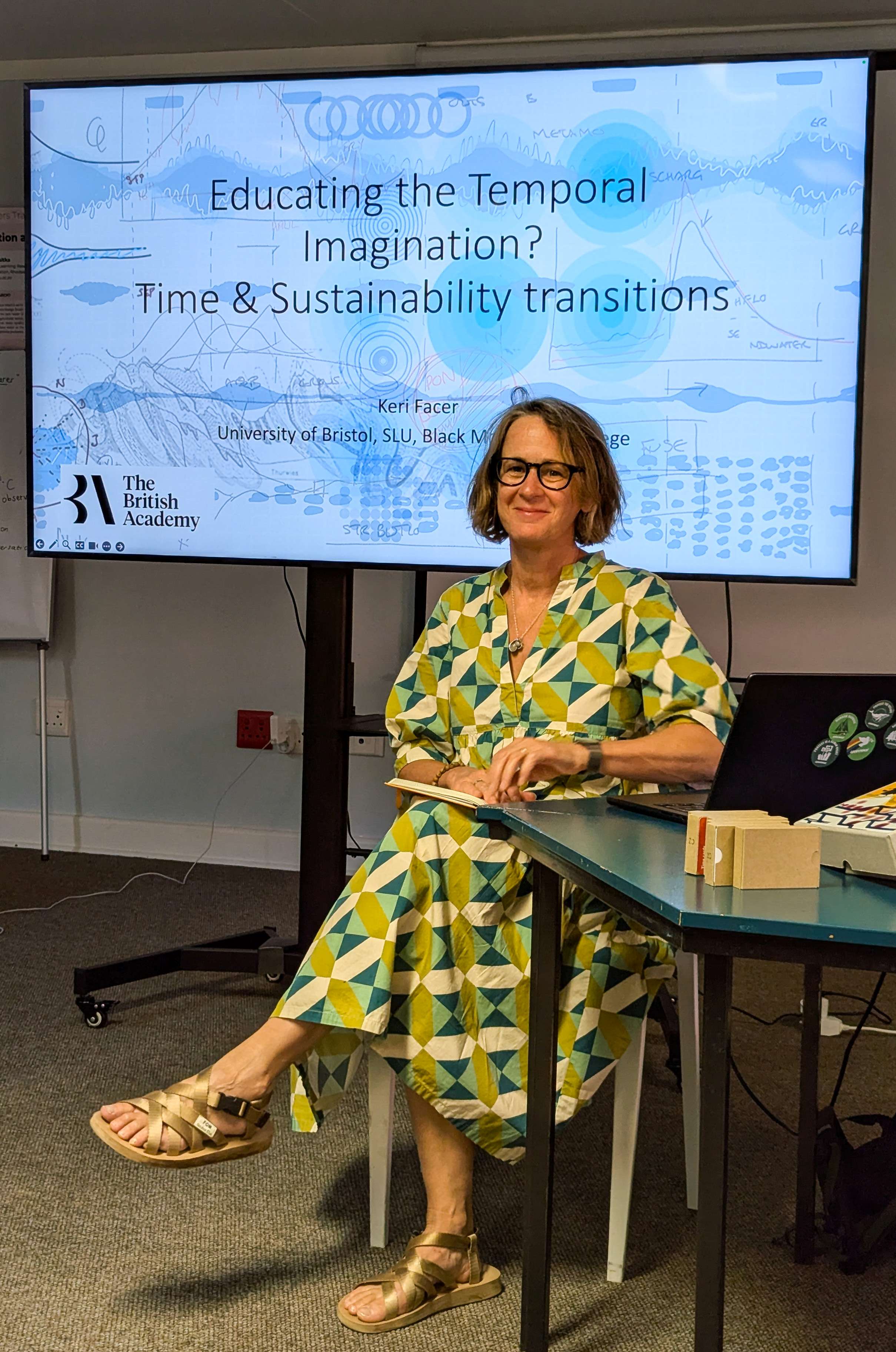
In November last year, the Environmental Learning Research Centre (ELRC) slowed down to reflect on time, hosting a British Academy (BA) workshop on ‘Time for a Just Transition’. Joined by visiting Professor Keri Facer (University of Bristol), ELRC staff and students interpreted their research and study areas through the lens of time, investigating how it influences the ways we think about education, sustainability, social justice, energy transitions, and climate adaptation.
The broader BA project, spearheaded by Facer, brings together scholars from six continents and 14 disciplines to transform our understanding of the role of time and timing in producing justice and injustice in sustainability transitions. Several ELRC scholars are co-researchers in the project, including ELRC postdoctoral researcher Dr Sarah van Borek, PhD scholar Luke Kaplan, and ELRC director, Distinguished Professor Heila Lotz-Sisitka.
Time, justice, and sustainability
Although we may not notice it, many concepts and norms surrounding time deeply influence our everyday lives and institutions, from the clock to working hours to our expectations about how society, learning, or progress should unfold. This is seen in ideas that societies should develop in a straight line from A to B, that education progresses neatly from one target to another, and that certain temporal trajectories, such as infinite economic growth in a resource-limited world, are ultimately unsustainable.
Distinguished Professor Lotz-Sisitka points out that South Africa ‘offers a tensely dynamic space for looking at time’. With its enduring legacies of European colonialism and Apartheid, the disruption of indigenous ways of life by norms of ‘modernity’, a diversity of people with different rhythms, a natural world teeming with a multitude of biological pulses, and a wealthy population producing some of the highest per capita carbon emissions alongside marginalised communities facing some of the worst climate change impacts, South Africa reveals how time, power, and justice are entangled.
A temporal lens for education
During the workshop, ELRC scholars explored how time influences work, education, and justice within South Africa’s transition to a low-carbon economy: time lags between declining fossil fuel sectors and emerging green sectors; the slowness of the skills system in recognising and supporting urgent climate adaptation work; and the complex process of upskilling and reskilling interventions regulated by short-term project funding. This culminated in a visit to Kidlinks farm near East London, an innovative project teaching rural youth about regenerative and sustainable farming, where time is marked by changing weather patterns and the pursuit of sustainable livelihoods.
In a guest lecture, Professor Facer explained how education can help to expand our ‘temporal imagination’ through helping us to conceive of different possible futures aimed at sustainability and justice. In a similar vein, Distinguished Professor Lotz-Sisitka contends that the languages, meanings, and rhythms of time remain hidden within education and learning systems and connects time studies to the notion of ‘possibility knowledges’: the potential for knowledge to move beyond our dominant categories, concepts, and understandings of the world. Such creative and dynamic thinking can spur what Lotz-Sisitka calls ‘transgressive’ learning: educational experiences that challenge practices, cultures, and systems that have become oppressive.
Working with(in) time at the ELRC
The BA time workshop played around with the places, metaphors, and melodies of time. Over four days, participants visualised and ‘languaged time with creative tools; explored African conceptions of time with Professor Obert Mlambo (Classics); engaged with archives at the International Library of African Music; reflected on the representation of time in filmmaking with Dr Borek; and delved into Makhanda’s past and present with Kaplan who took us on a walking tour to the 19th century Victorian Observatory Museum.
Although local and place-based in its exploration, the workshop was also global in character. An international seminar on temporal injustice featured insights from ELRC senior researcher, Dr Taryn Pereira, and her work with environmental community activists. We were also honoured to be joined online by Colombian-American anthropologist, Arturo Escobar, as well as several researchers working on the Global Atlas of Environmental Justice, a platform for tracking environmental harms and community responses.
The BA Times and ELRC collaboration will continue this year, with the ELRC planning to host a Time School for the Rhodes University community, and Dr van Borek creating a series of time-related films in partnership with various ELRC scholars, bringing their research to life with a pointed temporal lens. Watch this space!
To find out more about the BA Times for a Just Transition project: https://www.thebritishacademy.ac.uk/projects/the-times-of-a-just-transition/
Take a look at some photos from our Time Lab
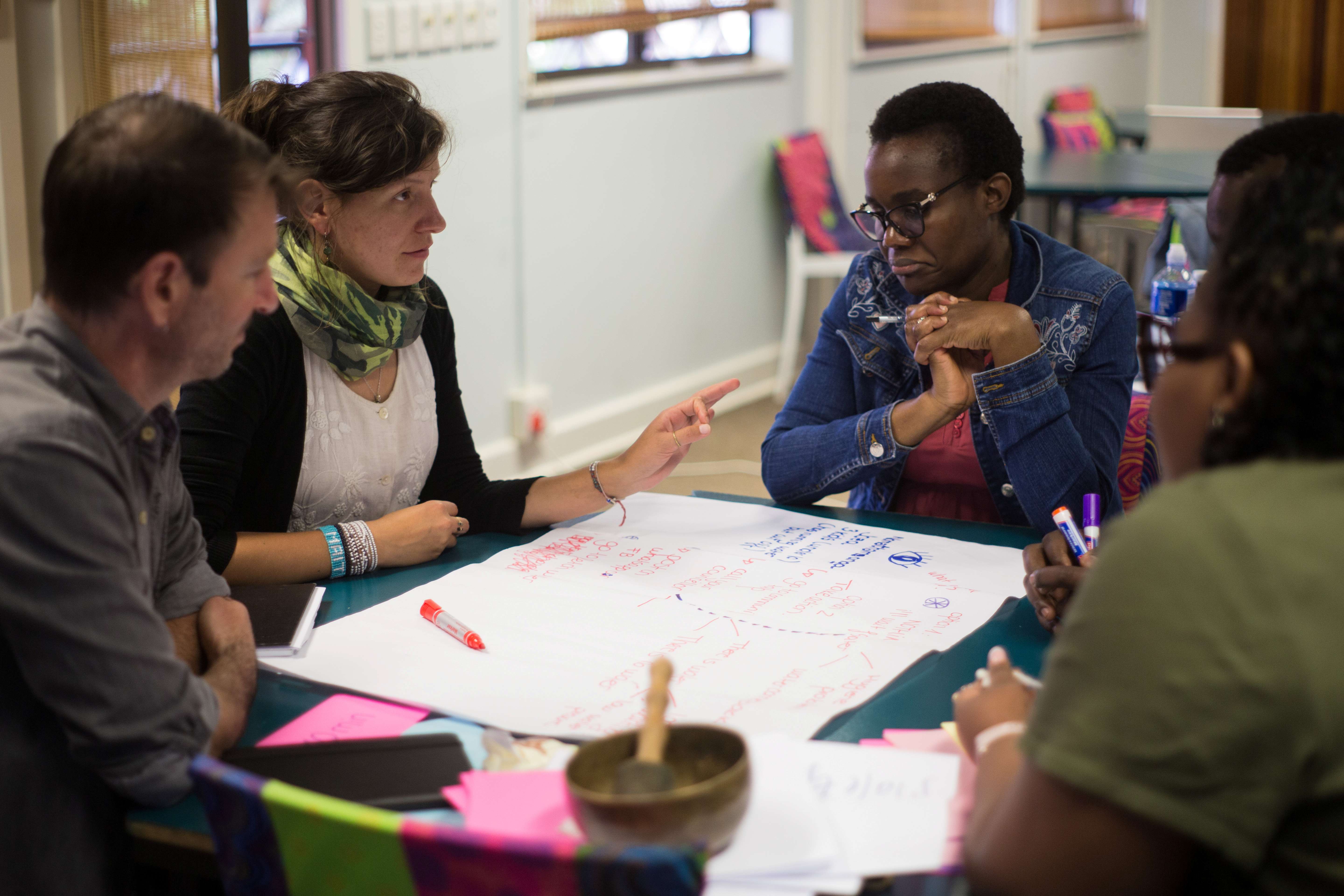
Workshop participants think about the representation of time in film-making. Here they contemplate the different pathways and decisions people make in response to a social issue, using it as a basis for a storyboard, reflecting how time impacts action and vice versa. Photo credit: Sam van Heerden.
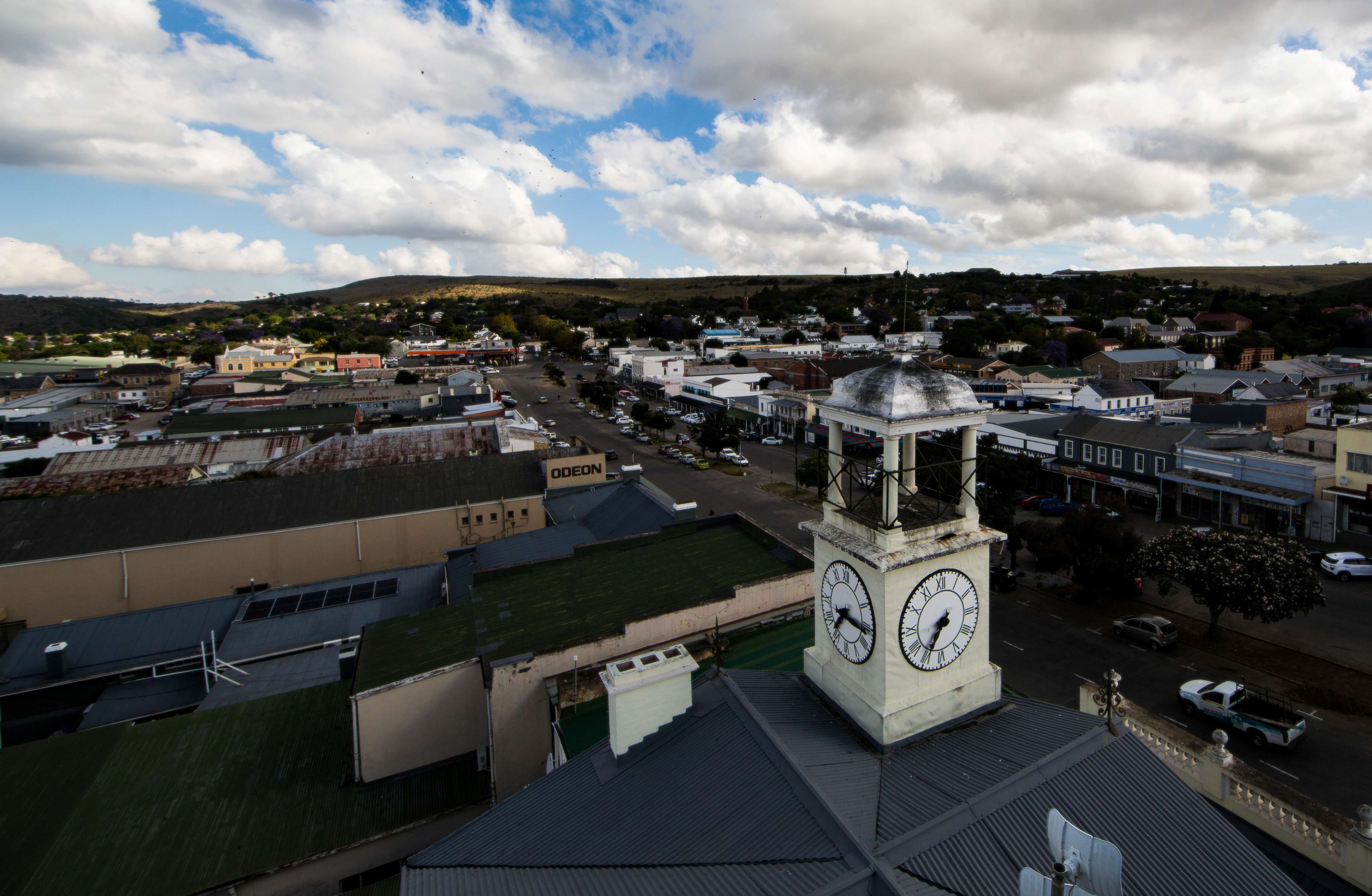
This clock tower of the Observatory Museum is part of an archive dedicated to 19th-century Victorian science, history, and architecture. It overlooks the modern town of Makhanda, both figuratively and literally, as it sits adjacent to the only Camera Obscura in the Southern Hemisphere housed in the Observatory Museum. Photo credit: Sam van Heerden.
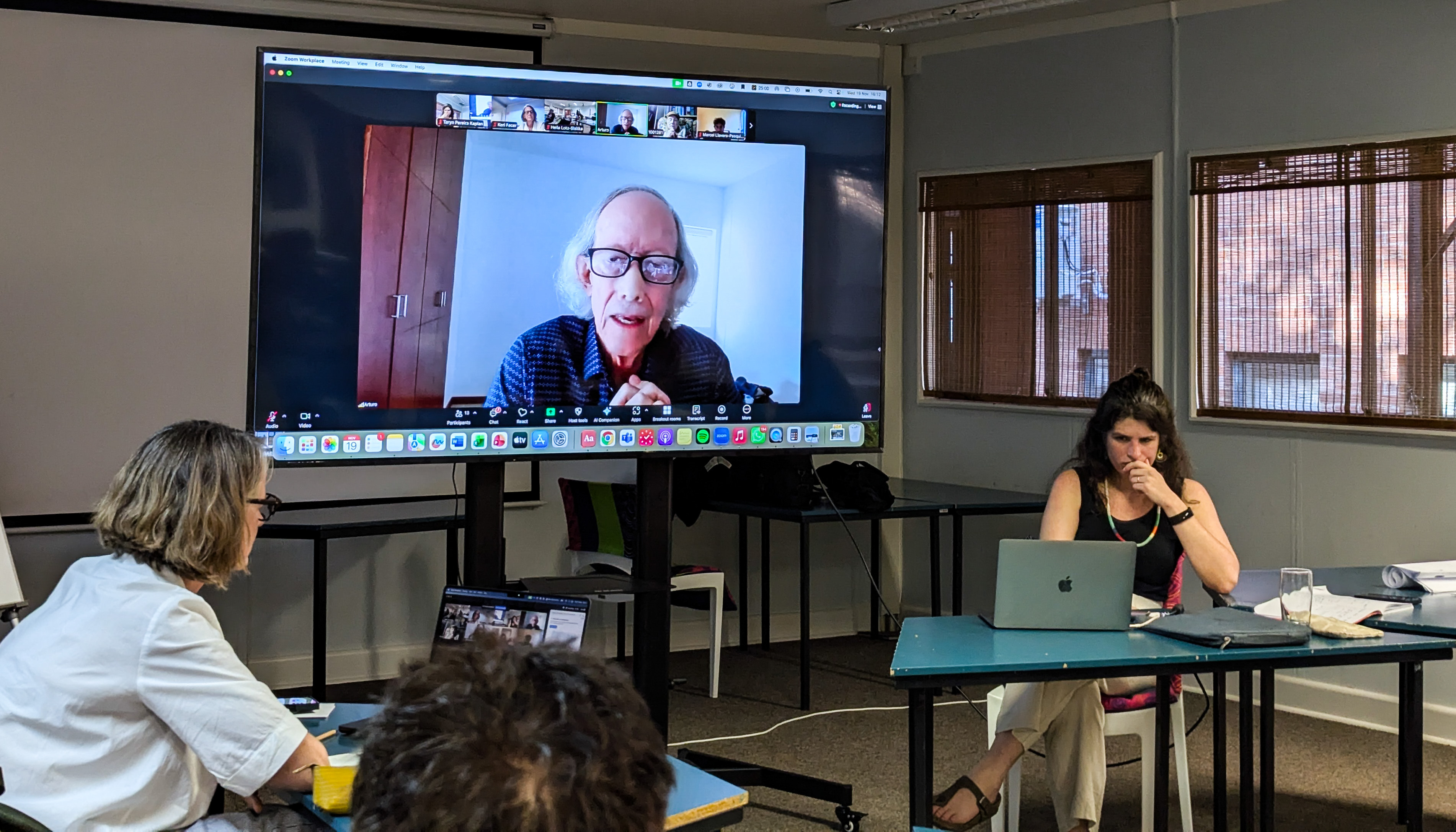
Colombian-American anthropologist, Arturo Escobar, gives an online lecture during the workshop. He critiques the 'colonial time' underpinning ideas about development. Senior ELRC researcher, Dr Taryn Pereira, sits below (right), after sharing her work done in collaboration with environmental activists in South Africa. Photo credit: Sam van Heerden.
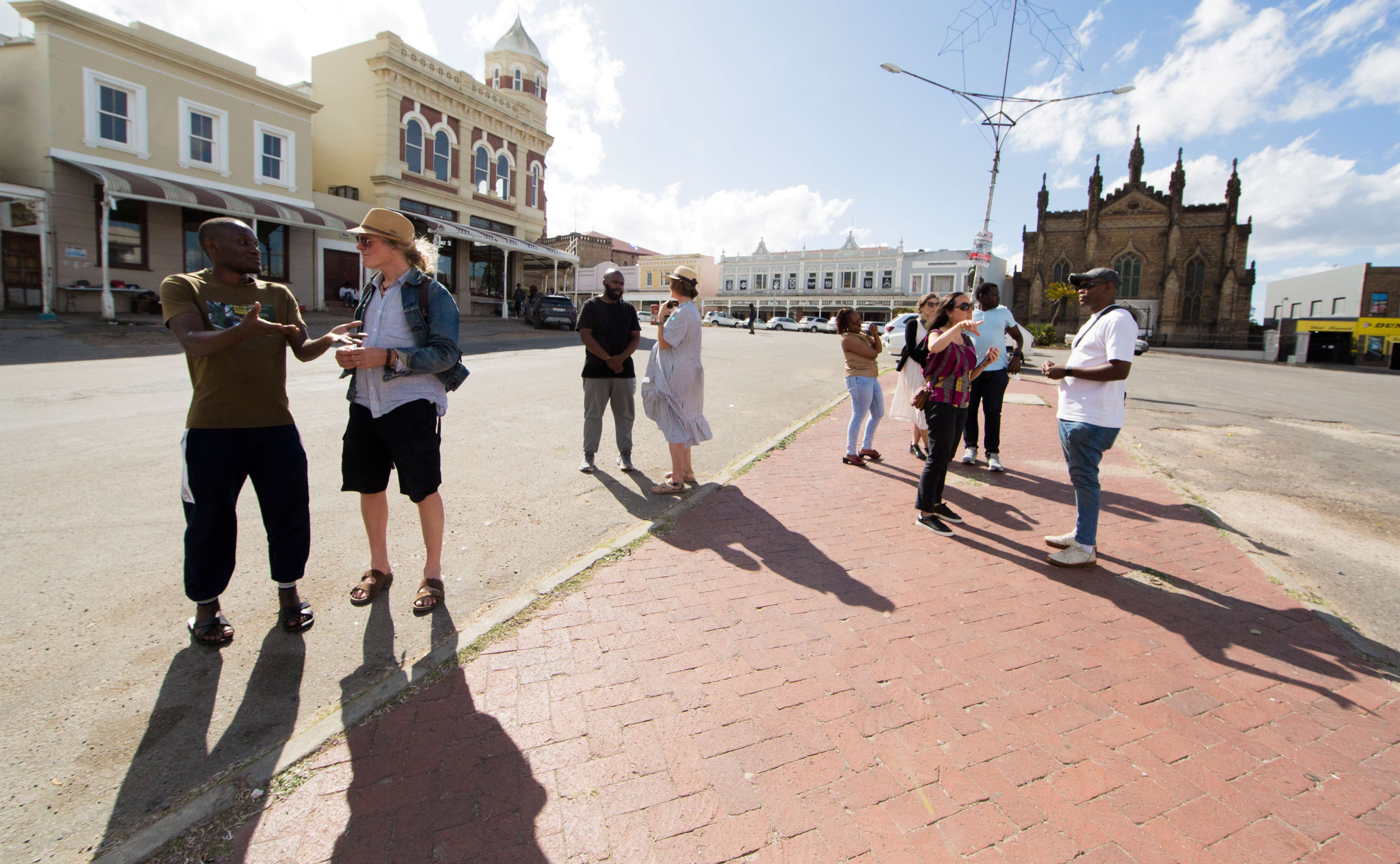 Time Lab workshop participants walk through Makhanda, guided by ELRC doctoral researcher, Luke Kaplan, who pointed out the layered history of the town into the present. Photo credit: Sam van Heerden.
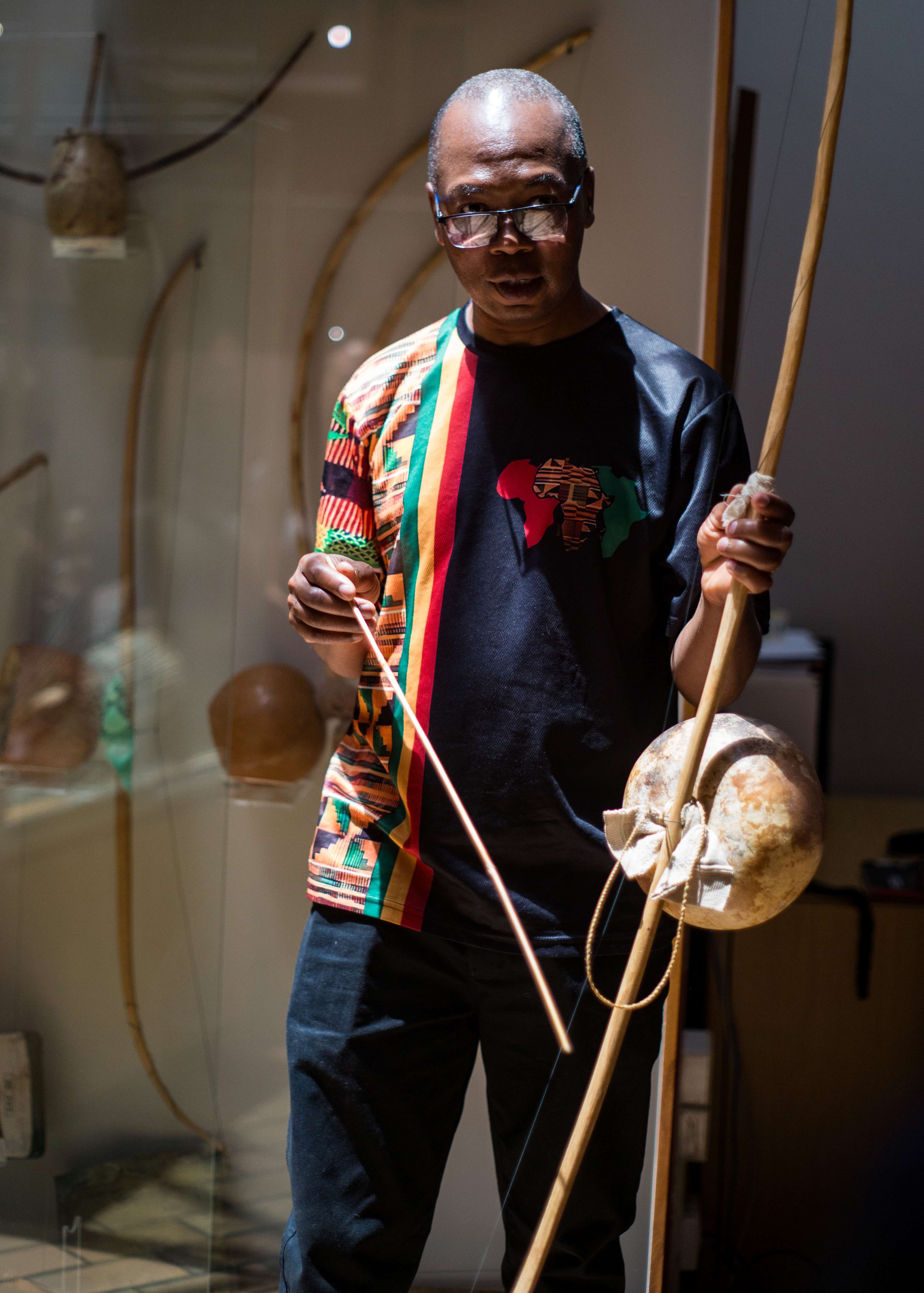
Its manager, Elijah Madiba, shows us some of the archive of the International Library of African Music (ILAM) at Rhodes University. Photo credit: Sam van Heerden.